Why do some packages of ground coffee seem a little "loose"?

Why do some packages of ground coffee seem a little "loose"?
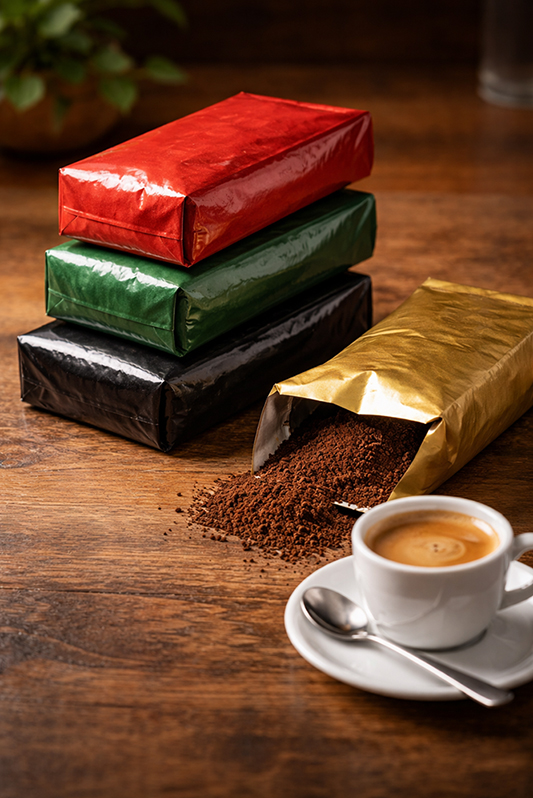
When buying ground coffee in a “brick” package, we may often notice that the package is not tightly compressed as we expected, but appears a little loose, as if it has “taken air”. This can often raise questions: “Is my coffee stale or spoiled?”.
In this article, we closely examine ground coffee packaging, dispelling myths and avoiding pitfalls, so that we always have the coffee we deserve in our cup.
 Why do some ground coffee packages seem a little “loose”?
Why do some ground coffee packages seem a little “loose”?
When coffee beans are roasted, the gases contained in the beans are released, a process that can take days. If our coffee is ground soon after roasting, the ground coffee continues to release gases, a process that is normal. So, during the packaging process, a small amount of air is always left inside, so that the coffee “breathes” slightly and is not compressed too much. So, the natural gases in the coffee are mainly responsible for the “loose” packages, which in no way means spoilage!
It is also important to remember that coffee is a natural product. The beans and their grinding have properties that affect how the package is filled. Ground coffee takes up more space than whole beans, but its density can vary depending on various factors, such as temperature, humidity, and the time of grinding and packaging. This means that two packages of the same weight can appear visually different: one more compact, the other more “loose”, but both contain the same quality of coffee.
Finally, the looseness of the package can also be linked to transportation. Small movements during distribution can have an impact on how tight or loose a 250-gram “block” of coffee appears, without however affecting its contents and quality in any way.
When should the “bells” start ringing?
If we detect a hole in the packaging (even a small one), this means that the "bloating" is indeed due to a problem in the packaging (which may have occurred during packaging or, more commonly, during transportation) and then it is certain that the coffee, for safety reasons and to ensure quality, is not good to consume. We should therefore contact the store where we purchased it, detailing the problems we identified, in order to initiate its replacement.
Modern packaging procedures include strict quality controls, so each batch is checked to ensure that the coffee is safe for consumption and that it retains all its aromas and flavors. If there are no obvious defects in the packaging (such as holes, tears, etc.), the possible looseness of the packaging is not an indication of spoilage.
In summary, if we see the packaging of our ground coffee a little loose, but we do not detect any defects, we do not need to worry. It is normal and does not affect the freshness, aroma or taste of the coffee. Our next espresso will be just as enjoyable, as if our “brick” were “stone”. Let our coffee speak for itself!


